Showing posts with label grapefruit. Show all posts

Sunday, November 2, 2014

With Citrus, Christmas Can't Be Far Away


Grapefruit - Rio Red
Bounteous amounts of citrus means the calendar is closing in on Christmas time.  Here in Bakersfield and probably most of the San Joaquin Valley, residents with citrus trees are looking for neighbors to unload the bounty.  Citrus is winter's zucchini - but in a very good way.  Citrus is my favorite. The scent is in everything from the bloom to the peel to the fruit.  It's even in the limbs when they are pruned.  Wonderful.  The fruit can remain on the tree for quite a long time so it can be harvested as needed.  Local nurseries sponsor citrus tasting events throughout the winter where gardeners can learn about the different varieties, sample the fruit/juice, and purchase health stock.

Grapefruit is my favorite citrus.  Rio Red is delicious.  My dwarf tree is weighted down with the most fruit ever.  That little tree should give enough fruit to last through the winter months.  No scurvy here.

Navel Oranges - Robertson
The fruit is now starting to gain color that is really accentuated by the rain washed leaves.  Yes, it rained yesterday and just a bit today.  Wonderful.  Some of the oranges have split.  That is probably due to uneven irrigation.  Any split fruit is removed as soon as it is detected and disposed.  2014 looks to be a bumper year for the oranges as well.

Lemon - Pink Variegated
Two of the fruit trees are potted - lemon and mandarin.  Neither have fruit.  The Satsuma mandarin is very young and having no fruit is expected while it develops.  The lemon, however, usually has some fruit.  Currently, it's blooming.  In the photo above, some Leaf Miner damage can be seen in the leaf on the left.  That's only cosmetic.

Leaf Miner Larva
Leaf Miner larva mine just below the surface of the young leaves and the skin of the fruit.  These moth babies are annoying but not scary like the Asian Citrus Psyllid that can carry the Huanglongbing (HLB or citrus greening) disease.  Many areas of California are quarantined because of this pest.   That pest is the reason I have not added a lime tree to my citrus collection. 

Asian Citrus Psyllid
In the meantime, it's a joy to work in the soft soil in the garden after some wonderful rain. (Let's not talk about the amount of dirt the wind blew in before the rain.  Yuck.)  All the winter vegetables are experiencing a growth boost with the cooler weather and the rain.

Lettuce - Cimmaron

Monday, May 5, 2014

Hello. Good Bye.

Some onions are about ready to burst attracting more pollinators to the garden.  Not many butterflies yet; but there are honey bees, bumble bees, and hummingbirds visiting.  More visitors to the garden are expected soon.


This weekend I searched for a grape tomato plant to help fill my mother's need for daily munchable tomatoes.  She can be found cruising the grocery store aisles popping tiny tomatoes before finally checking out and paying for her treat.  We went for a ride to a nursery on the other side of town and found an overpriced, gangly plant that should work.


Johnny's Select Seeds describes this variety:  Bite-size, firm, oval-shaped grape tomatoes. Fruits avg. 10 gm. Plants have medium-short internodes and are manageable without pruning, but staking is recommended. Determinate.  For the metric challenged, 1gm = 0.035274 oz.  I'm still looking for a couple of other varieties of small tomatoes to try.  Determinate would be great; but it's not a requirement.  The search continues.

Sweet Olive Tomato Planted 05/04/14
The lame plant is very spindly and was growing horizontally.  I removed it's lower sets of leaves and planted it deep in nicely amended soil with organic fertilizer.  A bamboo stake and green garden tape helped to convince Sweet Olive that she needs to stand up straight.  Sweet Kern River water was then applied to welcome Sweet Olive into the garden. 

Rio Red Grapefruit
Sadly, this is the last harvest from the grapefruit tree for 2014.  Supplies have lasted from the first of the year until now.  And I usually eat one grapefruit each morning.  Good bye, Rio Red.  See you again in a few months.  

That's pretty good - and delicious.  My daily fruit will now switch to berries - boysenberries, blueberries, and strawberries.

Monday, March 31, 2014

Grrrrrreat Grapefruit!

Rain! We received heavenly rain.  It even looks like we may receive more. Keep it coming. The weather is beautiful and cool. Most all of the spring blossoms have faded giving way to infant fruit that will surely drop as they develop. 
The Rio Red grapefruit tree is loaded with babies thanks to lots of busy bees.  In the photo above, the current crop being harvested can be seen below the new flush of growth.  I've had one grapefruit almost every morning since January. Wish I would have kept count.  Needless to say, there is no chance of a scurvy outbreak in this garden with grapefruit, orange, manderin, and lemon producing beautifully. The only imperfections would be the cosmetic damage from miners.  The next citrus tree I will bring to the garden is a Bearrs lime.  One of my favorite drinks is chunks of a variety of citrus all squished in a glass with ice and club soda.  So good.
Ajax doesn't care for citrus, but he's enjoying the cool beautiful weather.  High 5 paws for this great weather.  We need to duck inside.  It looks like the skies are threatening to open.

Thanks for the rain and snow!


Monday, December 20, 2010

Almost RED!

DSC_2243_5458

The Rio Red Grapefruit was planted February 14, 2009.  It looks like I may be able to enjoy fruit about 2 years after planting.  This is a dwarf variety and seems to be one of the more vigorous citrus trees here in the garden.  There are about 7 fruits on the tree.  The immature branches needed to be supported because the weight of the fruit is too much.

DSC_1474_4130The tree is planted in the ground on the west side of the shed.  It was sprayed with dormant oil earlier in the year.  It’s fertilized about every 6 – 8 weeks and watered irregularly.  One thing I learned is that citrus don’t like to be too wet.  In fact, a little neglect when it comes to irrigation seems to work better.  Leaf miners have invaded all of the citrus in the garden except for the new mandarin.  Hopefully the upcoming dormant spraying will control the damage of leaf curl and those snail like trails on the fruit skin.  Recent freezing conditions made it necessary to build a temporary cold frame around the tree.  The plastic gets draped over the frame as needed.  Currently, the tree is exposed to the wonderful steady rain California is enjoying.

Monday, May 3, 2010

Bees Do It

There’s more than just produce in the garden.  There’s a variety of flowers that attract the local bees.  It’s good to have them here to help with the pollination of the tomatoes, melons, squash…you get the point. 

DSC_1442_4099Lobelia

DSC_1433_4090 Lantana (yellow)

DSC_1434_4091 Thyme

DSC_1435_4092 Sweet Peas

DSC_1436_4093 Lantana (purple)

DSC_1437_4094 Lavender

DSC_1440_4097 Nasturtium

DSC_1443_4100 Strawberries

DSC_1444_4101 Grapefruit

DSC_1446_4103 Lemon

Note:  The fancy French radishes (Jaune D’Or Ovale) planted on April 28 look like they have sprouted; but it was too dark this evening to take any photos.

Thursday, April 8, 2010

Espalier Pruning

DSC_1020_3322

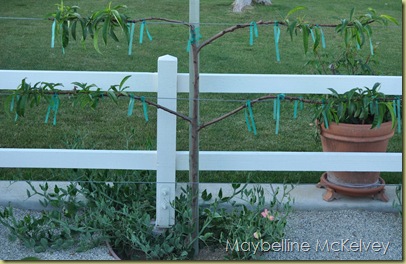
The deciduous fruit trees are all being espalier trained.  These baby trees are entering their 2nd year in the garden.  They all had a nice spurt of growth for the most part and needed a pruning.  Here’s the progress from January 1, 2010 to April 7, 2010 after their pruning.

Santa Rosa Plum – No fruit set.  Abundant leaves.DSC_1351_2745

DSC_1490_3858

O’Henry Peach – Fruit set for second year.DSC_1352_2746

DSC_1491_3859


Granny Smith Apple – Fruit set for second year.DSC_1353_2747

DSC_1492_3860


Warren Pear – No blossoms.  Abundant leaves.DSC_1355_2749

DSC_1493_3861

Fantasia Nectarine – No fruit set.  Lower left branch has no leaves.DSC_1356_2750

DSC_1494_3862

Blenheim Apricot – No fruit set.  Dang it.DSC_1357_2751

DSC_1495_3863

The bare root trees were planted on January 12, 2009.

January 12, 2009 – View westDSC_0153_085

April 7, 2010 – View westDSC_1497_3865


January 12, 2009 – View east.

DSC_0143_075


April 7, 2010 – View east.DSC_1500_3868

That’s a dwarf grapefruit tree in the background by the way.  It has blooms and little, baby fruit right now.  Looking healthy.

This is a tool I use to keep track of the progress in the garden and may be of no interest to anyone but me.  Thanks.

Friday, January 1, 2010

Dormant Care

Today, we pruned the roses, grape vine,  and espalier fruit trees, cleaned the beds around those pruned darlings, and sprayed dormant oil to protect from nasty insects and diseases.  The trees were planted about a year ago. 

DSC_0248_143 January 12, 2009 (planted)

There wasn’t any bounty from the trees this year.  2009 was the year to train the trees in espalier fashion.  There were 5 peaches, 3 apples, and a few bunches of grapes (Most were donated to the birds – those terrorists.) was the only fruit sampled from these new plants.  So far, so good.   Here’s how everything looked today, January 1, 2010:DSC_1347_2741 DSC_1351_2745 Santa Rosa Plum

DSC_1352_2746 O’Henry Peach

DSC_1353_2747 Granny Smith Apple

DSC_1354_2748 Red Flame Grape

DSC_1355_2749Warren Pear

DSC_1356_2750  Fantasia Nectarine

DSC_1357_2751 Blenheim Apricot

I’m pleased to report many earthworms in each of the tree beds.  There were also cutworms, cabbage loopers, cabbageworms, and earwigs (aka earrywigs).  We have lost many trees to borers in the past.  Hopefully this dormant maintenance will help cut down on the population of the destructive insects and any nasty diseases.

Let the year begin.  Happy 2010!

Note:  Second dormant oil application was on January 31, 2009, Sunday.