Showing posts with label Fantasia. Show all posts

Sunday, April 14, 2013

Augusta West - Not

It's time for the Masters' Tournament in Augusta, Georgia.  That golf course is famous for its azaleas.  My garden is not.  In 2009, we planted a bunch of camellias and azaleas in the garden.  Wrong.  They did bloom, but then they went kaput!  Only one azalea survives today.  Thriving in their place are thornless boysenberries
 George L. Taber Azalea
Garden Update:

Tomatoes (Better Boy):  Farmer MacGregor could not imagine a summer without homegrown tomatoes.  So rather than solarize the raised beds to eradicate the nematodes, he opted to plant a variety resistant to nematodes.  This is what we grew last summer in another bed. Planted last week.

Bell Peppers (Golden Bell):  Three plants should be enough to take us through the summer. Planted today.

Hot Peppers (Serrano):  Pepper poppers are a favorite around here.  MacGregor also prefers home grown salsa. So...Serranos were planted today.

Note:  I still cannot bend so Farmer MacGregor has taken on the task of planting.

Nectarine (Fantasia):  What's nibbling on the nectarines?  Ants?  Grasshoppers?
Fantasia Nectarines
Espalier:  All the espalier fruit trees (except for the Granny Smith apple) had a spring pruning.  Nothing too heavy.  The leaves are necessary to prevent scald.  The most vigorous growth was on the apricot and plum trees.

Saturday, March 9, 2013

Orchard Update


 The garden orchard isn't big at all.  All the deciduous trees are espalier pruned to shadow the garden fence line.  (The citrus grow on the opposite side of that fence line with the raised beds on the same side as the espalier trees.  All these trees were planted in January 2009 as bare root babies.
Warren Pear
The Warren pear has refused to bloom. This is the 4th year in the garden without so much of a hint of a bud.  The leaves are beautiful, glossy, and green.  In fact, the pear tree is known as the diva of the garden.  It really is a great tree to form an espalier.

Granny Smith Apple
Old Granny Smith was thought to be a gonner due to sun scald.  Using tree wrap saved it and now the tree is producing nice fruit.  This spring, there is an abundance of blossoms - the most in it's short life.  This is the last tree to bloom in spring and the last fruit to ripen at the end of summer.

O'Henry Peach
 
O'Henry had a bad case of sun scald like the apple tree.  The tree wrap did a great job.  Last summer I concentrated on developing a nice canopy to naturally shade the limbs.  This year, wrap will be applied to any tree that needs it.  And, this peach tree is blooming like made so there is hope for a good crop of fruit.

Fantasia Nectarine
Last year, the nectarine had to be replaced.  Same variety - better production.  The previous tree had rare blooms and when it was removed there were no roots.  None.  This fantasia has about 15 blooms this spring; but something is nibbling on them.  Ants?

Santa Rosa Plum
Fruit is already forming on the plum tree.  There are an estimated 5 billion blossoms on the tree this spring.  That's a very rough estimate.  I'm hopeful to be able to make plum jelly this summer.  Santa Rosa was the 1st to bloom; but it's not the mightiest producer.  No sir.

Blenheim Apricot
Even though the apricot had to undergo some major surgery recently, that did not stop the fruit production.  This tree is the 2nd to bloom but is surging ahead as far as production is concerned. Dried apricots are my favorites.  I'm hopeful.

Saturday, December 29, 2012

Tree Trimming

O'Henry Peach
Some of the fruit trees have finally lost their leaves. I understand that waiting to prune after all the leaves have dropped allows the leaves to provide nourishment to the tree.  Am I right?  Today, I wondered out to do a little clean up pruning on the peach tree. This tree did surprisingly well this year.  The trunk had suffered sun scald and I thought it might need to be replaced.  Wrapping the trunk this summer helped to protect the exposed trunk and some branches allowing more growth to flourish and help shade those wrapped parts.  I only removed branches/twigs that were crossing, dead wood, and branches that might cause a problem. 

Debris needs to be removed from around the trunk; but other than that, it's ready for an application of dormant oil.

Only one other tree has dropped its leaves.  The new, replacement Fantasia Nectarine.  It's still a squirt and needs no pruning.  Just a little rake around the base and this little lady is ready for a shower.
Fantasia Nectarine
Garden Update:
Farmer MacGregor tackled the removal of Gold Currant Tomatoes yesterday.  These volunteers grew in a bed dedicated to the eradication of  Root Knot Nematodes.  Earlier in the summer, French Marigolds were planted. I read that this variety of marigold repelled these pests.  JUNK!  The knots on the roots of the tomatoes were gross.  We have decided this summer will be the summer to cover all the vegetable beds with black plastic and bake those buggers.  I have one pot reserved for a tomato plant and that's it.

I had also read that nematodes don't like mustard; so I planted 4 varieties this fall.  The mustard bed is thriving.  Asparagus is growing in this bed as well.  Don't know what to do with the asparagus when the black plastic is draped over this bed.  Suggestions?

Southern Giant Curled Mustard

Sunday, March 25, 2012

Nectarine vs Terrorism

The original Fantasia Nectarine bit the dust and needed to be replaced.  Fortunately, I found a bare root specimen at Robby’s Nursery.  Last Sunday (March 18, 2012), I was able to chat with Old Man “Robby” Robinson regarding my replacement choices.  My main concern was the different rootstock used.  He assured me that since I will be pruning my tree espalier, that the trunk would not grow larger than the other fruit trees on the fence line.  The trunks grow to meet the demand of the tree tops.The Fantasia Nectarine is described as very large, flesh yellow, firm, smooth textured, sweet & juicy.  It is freestone and can tolerate frost.  The fruit should ripen in July.

As Robby recommended, the roots were trimmed and the branched pruned back.  The most suitable lateral branches for the bottom and middle lines were bent along the guide wire while the others were pruned.  The top laterals haven’t developed enough to bend. Those branches were left to develop any fruit until they have grown long enough to bend.The garden terrorist is aware of the new addition and is probably quite pleased that he may have had a hand (mouth) in bringing an end to Fantasia I.  I’m watching that guy.

Thursday, January 19, 2012

Guilty!

DSC_2195A crime has been committed. 

The identity of the suspect has been hidden to protect any innocence (There is none!).  This afternoon, I discovered that damaged had occurred to the nectarine and apricot trees.  Some beast had chewed on the dormant branches.  In the case of the nectarine, a large chunk of a branch had been broken clean off!

EXHIBIT A:DSC_2197The Fantasia Nectarine has been struggling but was looking promising.  A lower limb had been snapped off and munched.  Note:  Damage does not appear to be from a beaver as there is no body of water near.

EXHIBIT B:DSC_2198The Blenheim Apricot is a much more vigorous specimen.  An apricot limb adjacent to the snapped nectarine limb sustained damage from some sharp toothed demon.

Evidence was collected from the surrounding area for analysis.  Witnesses were interviewed with statements recorded.  A round up of the “usual suspect(s)” was performed.DSC_2200Justice was swift.  The perpetrator felt great remorse and was released on his own recognizance.  He’s on probation and is on his best behavior.

Note:  The dormant trees were dormant sprayed for the 2nd time this season after the damaged trees were lightly pruned.

Sunday, June 5, 2011

Espalier Growth

Most the fruit trees in the garden are espalier trained.  Sorry if the word “espalier” is misused.  Though the trees grow two dimensionally  along the XY axes sometimes they need to get their Z  clipped too.    Since the weather has been so incredibly tolerable, gardeners are out in force to doing what chores they can before someone opens the furnace door.  This evening a few of the trees got trimmed a bit.

Here’s some before and after shots:

Plum – Santa Rosa:  Still growing strong, Santa Rosa is an excellent variety for this climate.  This is the first year that a harvest is expected.  There is still loads of fruit tucked up under that thick, green canopy.  Early June is the expected time to harvest.  This year things are going slower because of the cooler weather; but Santa Rosa should be the first of the fruits to harvest.

DSC_2229_6586       DSC_2236_6593

Peach – O’Henry:  This tree has produced fruit before but this season is a bit heavier.  The leaves only grow on the tips of the branches but this season they are growing denser.  This should help filter out the sun and prevent sun scald.  Umbrellas will be planted next to the trunk and opened when the sun gets more intense.  The fruit may be harvested starting in mid August.

DSC_2231_6588       DSC_2237_6594

Nectarine – Fantasia:  The peach and nectarine are similar in growth with the leaves growing at the tips of the branches.  The nectarine is doing a great job producing leaves.  This tree almost fell to pruning shears to make way for another tree.  I really thought this tree wasn’t going to work out.  An umbrella is set up already for this tree and has been opened to help shade the exposed trunk and branches and prevent sun scald.  Sadly, the one fruit that formed failed.  An future harvest should be from mid July to mid August.  I’m hopeful.

DSC_2234_6591        DSC_2238_6595

Apricot – Bleinheim:  The apricot produces an abundance of leaves.  It’s more productive than the successful plum tree.  No fruit has been harvested yet but it’s hanging under the cool shade getting plumper and more delicious with each day.  Harvest is expected in late June.

DSC_2235_6592        DSC_2240_6597


A couple of the trees didn’t warrant a pruning.

Apple – Granny Smith:  These should be ready in August or October sometime.  There are conflicting opinions.  Regular sampling will be needed to determine harvest time.

DSC_2219_6576

Pear – Warren:  No fruit this year.  I have no idea when to expect a harvest; but this tree takes well to being trained espalier.      DSC_2233_6590

Thursday, June 2, 2011

Mother Nature Continues to be a Mutha

DSC_2199_6556Apricot – Blenheim

Okay.  It’s difficult for me and many like me to thin vegetation in the garden.  Things like onions are much easier as the baby onions are harvested to use as green onions.  Items like apricots are something I leave completely to Mother Nature.  The outcome seems to be the same whether it’s me or nature doing the work.  The strong survive.  The only fruit on the nectarine dropped recently.  It was a sad piece of fruit that was destined to wither.

This evening I was clipping the parsley, thyme, and chives when my pruning shears demonstrated exactly how sharp they really are.  Slash!  The drip line was clipped clean through.  Luckily Farmer MacGregor has extra line in the shed and the repairs were made.  While cleaning up the clippings (along with the black widows and earwigs) I noticed that Mother Nature was again having her way in the garden.  A few more apricots will not reach maturity.  They rested on the gravel almost as helpless as a young mourning dove.

The trees are due for another trimming/fertilizing session.  No threat of sunscald yet with the wonderfully cool weather that is lulling most of us into a very false sense of security.  July is on the way.

Garden Note:

  • Radishes planted as beneficials amongst the pumpkins.
  • Parsley and green onions planted as beneficials to the tomatoes.
  • Coneflowers, nasturtiums, zinnias, and some other flower seeds I picked up at the Rite Aid were planted in the front yard flower beds.
  • The 1st tomato set on a plant mislabeled as Al Kuffa.  This is a mystery variety.  It looks to be a tall, lanky variety.  Maybe as time goes on I’ll be able to determine what variety it is.
DSC_2196_6553

Tomato – Variety unknown

Friday, May 13, 2011

Fruit Trees

Most all the fruit trees are producing great this year.  They are 3 years old and trained espalier to keep them manageable, tidy, and productive.  Organic fertilizer is applied about every 4 - 6 weeks.  Irrigation occurs as needed.  I use a moisture meter to determine when to soak the basins.  Pruning/pinching happens as needed and it’s been needed quite a bit lately.  So far, the trees have been pruned 3 – 4 times this spring.  The goal is to encourage a dense canopy over the open branches to avoid any sun scald to the fruit, trunk, or branches.  The wire cable seen in some images is used to train the espalier.  When the branches mature, it will be removed.
DSC_2600_6470

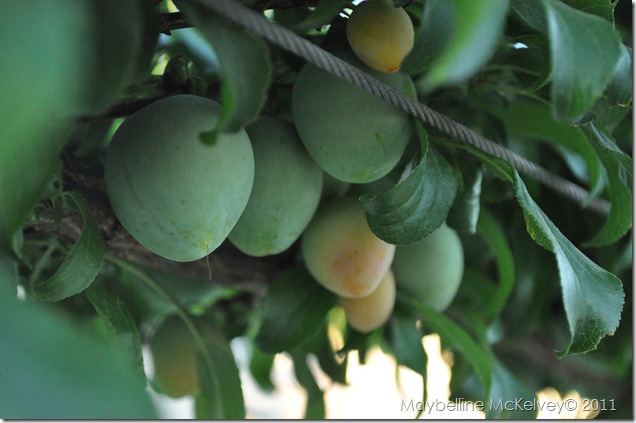
Plum - Santa Rosa

Plum – Santa Rosa:  This is the western most tree and maybe the hardiest.  The fruit is really developing nicely with the weaker ones thinning out naturally.  Thank goodness.  Thinning is taxing to me psychologically. Seeing the smaller, weaker plums take a dive for Darwinism helps me out.  Thanks weaklings.
DSC_2599_6469

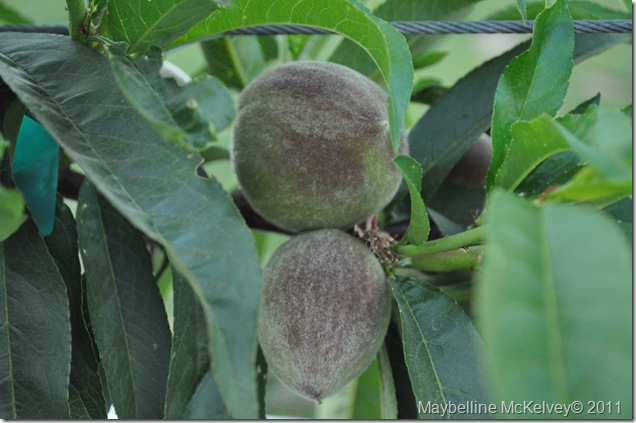
Peach – O’Henry

Peach – O’Henry:  Pinching the tender new growth of the peach tree is a snap and can be do simply using my fingernails.  By pinching the tips, new growth is forced elsewhere helping to form a thicker shade canopy.  The peach isn’t the most vigorous tree but the fruit is really good.

DSC_2597_6467

Apple – Granny Smith

Apple – Granny Smith:  Not many fruit was produced in 2010 on this tree.  2011 looks to be way more successful.  These should be ready to harvest in August.  Old Granny had sun scald troubles.  Umbrellas will be used to shade any trees that are showing signs of being sensitive to the sun.  The umbrellas will go up nonetheless to comfort a whiney gardener with swamp pants.

Pear – Warren:  Sadly, I didn’t snap off a picture of Warren.  There are no fruit but the foliage is looking great.  Pears are some of the easiest trees to espalier train.

DSC_2596_6466

Nectarine – Fantasia

Nectarine – Fantasia:  Poor thing.  This is the 1st year any fruit has formed.  Sadly encouraging.  This tree suffered major sun scald.  I thought it would need to be replaced this past winter.  But it seems to be producing.  The goal is to encourage more leaves and make it stronger. 

DSC_2595_6465

Apricot – Blenheim

Apricot – Blenheim:  One of my favorites.  “Who put the ape in apricot?”  Name the movie.  This is really exciting to have a healthy apricot tree.  Blenheim sits at the eastern most point on the line of espaliers.  It is as vigorous as the plum.  New growth is regularly pruned/pinched.  Only recently has it begun to shed weaker fruits.  There are still plenty of beautiful, healthy apricots that should be ready in a few more weeks.

Another application of fertilizer is due in the next few weeks.  The trees were last fertilized during the 2nd weekend in April.  Heck.  This weekend seems like a fine time to feed these hungry babies.

Wednesday, April 27, 2011

Tree Inspection

Some notable things are happening this spring in the garden as the trees mature.  For example, most all the trees are holding the most fruit they have ever produced.  At the same time, I thought the nectarine was doomed.  Not so fast.  An inspection revealed at least one viable piece of fruit.  There are others but those are so weak they will most likely blow away with the next breeze.

DSC_2557_6402

Nectarine – Fantasia

Citrus blossoms are plentiful on all of the citrus trees – lemon, mandarin, orange, and grapefruit.  The mandarin is the youngest of the citrus and has loads of little mandarins that should be ready around Christmas time.

DSC_2561_6406 Mandarin – Owari Satsuma

Lacking in age means this tree is lacking in strength to hold all this fruit.  Most will be lost until the tree is old enough to support the weight.  While inspecting the tree I spotted the thorns that are prevalent on citrus trees.  Holy Cow!

DSC_2568_6413

There are several thorns that measure around 5 inches.  Are these thorns?  They sure look like thorns; but mandarins aren’t noted for having thorns.  The thorns don’t appear to be growing from the scion so I can’t explain this nor do I know what to do – if I do anything.  The thorns were growing from the scion with some strange leaves.  Late tonight when I was outside re-examining the thorns to confirm where on the tree they were growing, the fragile branch broke off just like a sucker should.  Problem solved.

This is a tree from Four Winds Growers out of Winters, California.  That’s up by Sacramento.  Now Sacramento is famous for growing loads of blow hard politicians but I’ve never known them to be famous for thorns.  There is most probably no correlation.

Thursday, March 24, 2011

In The Leafy Treetops

  The skies parted for a time this afternoon for a little garden inspection.  After checking the progress in the vegetable beds (nothing to note), I checked  on  the trees to see how they came through the wind and rain storms we’ve had recently.

DSC_2611_6195Granny Smith Apple

Apple buds are plentiful on old Granny.  This year is the best ever; but she’s not out of the woods yet.  There’s more wind to come that will, more than likely, thin out the bounty.  Note the dark sky making a great backdrop for the sun beaming on the buds.


DSC_2610_6194O’Henry Peach

In various stages of blooming, the peach tree looks like it may produce fairly well this season.  I’ll be concentrating on creating a thicker canopy to protect the trunk and limbs from the scorching sun.


DSC_2613_6197Santa Rosa Plum

A canopy like the Santa Rosa Plum produced would certainly help prevent sun scald on some of the other trees.  The plum made it through the storms in good shape.  Sadly, there were no plums that survived.  Wait a minute.  What? 


DSC_2623_6206 Santa Rosa Plum

There’s a bajillion more clusterslike this under that canopy.  Many of the tiny plums are sure to drop.  I hope I can at least taste one this summer…at most, jar up some plum jelly.


DSC_2618_6201 Warren Pear

A small amount of damage caused by the wind was noted on the Warren Pear.  It didn’t bloom this spring so no blooms to worry about.  It’s getting a nice start on producing a thicker canopy.


DSC_2620_6203 Fantasia Nectarine

This tree is the #1 candidate for sun protection.  The nectarine really needs a canopy.  In the meantime, a temporary screen will be erected.  I sure hope more leaves will sprout.  The blooms are similar to the peach tree…if they would only produce a piece of fruit.


DSC_2621_6204 Blenheim Apricot

Baby apricots made it through the storms!  No fruit has made it to maturity on the apricot tree.  It looks promising for this summer though.  The plum tree bloomed before the apricot; but the apricots are much bigger than the plums.

All the fruit trees were fertilized on February 20.  They will be fed again during the 1st weekend of April.  A six week fertilizer plan should do for now with adjustments when the weather changes and the growth slows.  Just want to track this and see any progress.


By clicking on any image a new window should open with a much bigger version.  That is IF I remembered to make that feature available.

Saturday, March 12, 2011

Espalier Progress

Most all the trees have buds breaking.  Today the Warren Pear finally joined the others.  Sadly, it seems that all the buds are leaves.  References state that fruit may not be produced up until the tree’s fifth year.  This pear tree was planted in January 2009 so there is still hope…just not this year.

DSC_2588_6131

Warren Pear

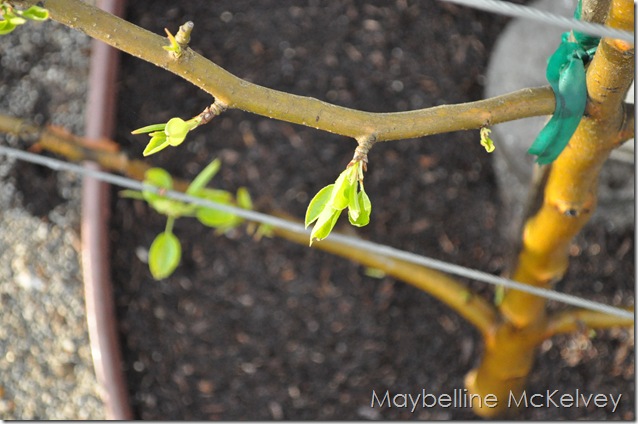
One of the trees grafted earlier this year was the Fantasia Nectarine.  It needs more lateral branches because of sun scald (I have determined without any formal training so…).  So far the grafted scions have not shown signs of life ; but the upper branches are bursting.  No fruit has been produced to date; but this may be the year.  This tree was also planted in January 2009.

DSC_2579_6122

Fantacia Nectarine

Not only are the fruit trees coming to life, the Red Flame Grape is stirring.  Farmer MacGregor is the master pruner of this vine as it matures over the arbor he built.

DSC_2577_6120

Red Flame Grape

All of the fruit trees and the grape vine have been fertilized but they really needed some mulch to set them up right for the hot summer ahead.  I went and got a few bags, came home and cleaned out the garden wagon, then got busy.

DSC_2584_6127

The trees are almost ready to face summer.  The only thing left is to rig up some kind of shade structure to protect this mini orchard from more sun damage.


Note:  If Kellogg would like to send me more Gardener & Bloome, I would shamelessly post the benefits of their product that is 15% chicken $h!t.  Even though it’s super stinky, it seems to help the garden grow.  Until then, I’ll continue to buy the stuff at my local nursery.DSC_2586_6129 For every gardener still living in winter, the reflection on the bag of Harvest Supreme is not a flash from the camera…it’s just that Lucky Old Sun.


Saturday, February 19, 2011

This Bud’s For You

With the moist winter we’ve been experiencing and the warmer, longer days, the buds in the garden are bursting or on the verge.  Today there was light rain in the San Joaquin Valley and a dusting of snow in Tehachapi.  It was a nice surprise to top off an afternoon drive up the hill.  Before the drive, we went to the citrus tasting at White Forest Nursery.  The only thing I bought was a couple packets of Teddy Bear Sunflower seeds. 

Here is the promise of spring:


DSC_2522_5997 Strawberry

DSC_2523_5996 Dandelion

DSC_2524_5995 Lilac (lobelia in background)

DSC_2525_5994 Chrysanthemum

DSC_2527_5992 Santa Rosa Plum

DSC_2528_5991O’Henry Peach

DSC_2529_5990 Granny Smith Apple

DSC_2530_5989 Warren Pear

DSC_2531_5988Fantasia Nectarine

 DSC_2533_5986 Blenheim Apricot

DSC_2534_5999 Lantana – Purple

DSC_2535_6000 Oxalis

DSC_2536_6001Lantana – Yellow

DSC_2538_6003  Begonia

DSC_2539_6004Azalea - George L. Taber

DSC_2548_6028 Lemon – Variegated Pink