Sunday, August 12, 2012

Vines

Mandevilla "Rio Deep Red"
Tender vining, compact shrub with glossy leaves and large, 3" dark red trumpet shaped flowers.  Great for hot, humid areas.  Water regularly and plant in a well drained acid, raised bed or container.  Protect from frost.
I picked up a red Mandevilla recently at Lowe's.  I do not typically purchase nursery items from box stores; but I was there while Farmer MacGregor was on a hardware run.  (He doesn't bother going to my favorite local hardware store - Floyd's.)  Now I'm searching for an unusual trellis.

This has been potted and placed on the east side of the pergola.  The pot rests on large pebbles in a saucer on terra cota feet.  It must be loving the recent hot, humid weather (aka swamp pants weather).
Sweet Potato Vine
I also picked up a sweet potato vine.  It's a vigorous grower that can make a big impact.It comes in chartreuse or purple.  I like chartreuse. Sweet potato vines do best during the warm days of summer and prefer moist, well-drained soil. They thrive in sun or shade.  This guy is in a hanging basket on the west side of the pergola and receives hot sun from mid-day until sunset.
Other non-edible vines in the garden are Wisteria and Jasemine.  Wisteria grows on the pergola to shade the east side.  Jasemine grows on the east side of the house getting punched by the sun from mid-morning to early afternoon.  So far, so good.  Everyone seems happy.  That's good because it has been too danged opressive out there to tend to anything. 
Come on October!  Let me hear you.

Saturday, August 4, 2012

Farmer MacGregor's Patio

Because it's hot and humid outside AND because I'm a wilting flower, this afternoon I played around with Windows Live Movie Maker. This effort is to chronicle the new patio that Farmer MacGregor installed this spring.  He's tired of waiting to see something posted regarding this nice work. 

Note:  This is a novice attempt.   Hollywood has nothing to fear. Now sit back and enjoy your popcorn.

Thursday, August 2, 2012

Problem Solved?

Root Knot Nematode damage was discovered in the fall of 2011.  French Marigolds are supposed to repel the boogers and starve them out.With that, seeds and seedlings were planted throughout the vegetable patch.  One bed in particular was going to be dedicated exclusively to the marigolds letting them reseed themselves then turn the spent plants under in the fall.  Sometimes plans just don't work out.
Volunteer Gold Currant Tomatoes have gone bonkers and are competing with the marigolds for turf.  The tomato plants are so loaded with the grape sized tomatoes that they constantly need to be restaked. This variety of tomato has been sprouting all over the garden this summer.  Why fight it?  If something good wants to grow with little to no work, I'm all for it.

Marigolds (Only the French variety are supposed to repel nematodes.) were also planted in the planned tomato patch.  The tomatoes (Celebrity) are nematode resistant.  So far so good.  Asparagus was also planted to end the pest problem.  Again, so far so good.  Basil seeds were sown throughout this patch along with oregano.  Bingo.  Everything seems to be working fine.  If Root Knot Nematodes still exist in the beds, they are not causing any problems.  With crop rotation and continued use of my new French friends, this problem should only be a memory.

Now I need to research what to plant in the fall to continue this success.

Sunday, July 29, 2012

Granny (Maria Ann Sherwood) Smith

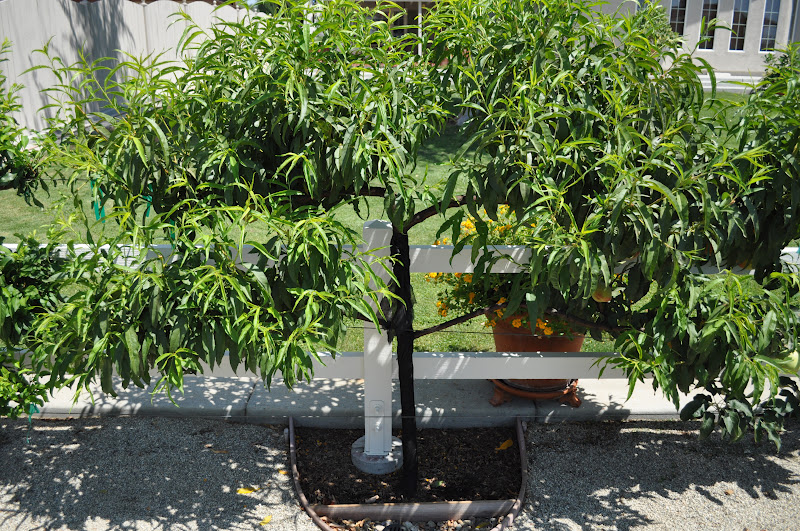
The Granny Smith Apple tree is enjoying a healthy year of growth.  Just like the O'Henry Peach, the exposed trunk was wrapped for protection from sunburn/sun scald.  The immature trunk was cracking and blistering until shade or cover was provided.  This method of protection is giving much better results than using the Tommy Bahama umbrellas - although in 2011, Farmer MacGregor constructed a sun screen using shade cloth and fence posts.  The wrap is much easier. The tree is getting the amount of sun needed while the wrap is providing protection.
Granny Smith Apple - January 1, 2010
Also like the peach tree, the apple tree was only producing leaves at the ends of the limbs - similar to pom poms.  It has produced apples all along since it was planted in 2009.  Apples are plumping up (see 1st image above) and should be ready sometime in October-November according to the Dave Wilson tag that was attached to the sapling.
Granny Smith Apple - July 29. 2012
Today, the tree continues to bloom and produce more leaves to shade the limbs and branches.  Pruning the apple tree is rare.  The spurs which produce the fruit season after season form on wood at least 1 year old.  Since this is an immature tree, spur growth is welcome.

Granny Smith Trivia:
The cultivar originated in Eastwood, New South Wales, Australia (now a suburb of Sydney) in 1868 from a chance seedling propagated by Kentish-born Maria Ann Smith (nee Sherwood 1799-1870), from whom comes the name.  Widely propagated in New Zealand, it was introduced to the United Kingdom around 1935 and the United States in 1972 by Grady Auvil.  The advent of the Granny Smith Apple is celebrated annually in Eastwood with the Granny Smith Festival. - so says Wikipedia.

Good Ol' Maria Ann Sherwood Smith - Granny Smith

Saturday, July 21, 2012

Patience is a Peachy Virtue

January 2009 - A line of fruit trees was planted along the garden fence with hopes of a small espalier orchard.  For the most part, the undertaking has been successful.  Some trees thrived more than others.  The first nectarine tree was pulled out in early 2012 and replaced.  It's replacement is thriving.  Another tree that was planted in shaky ground was the O'Henry Peach.  Growth was only evident at the ends of the limbs and not very robust.
O'Henry Peach - July 21, 2010
Even though it produced a few peaches, it was pretty measly.  When starting a young fruit tree, fruit should be plucked to encourage plant growth rather than fruit production.  I can't do that and that's one of my weaknesses.  Soil was amended and fertilizer was applied along with essential irrigation to ensure a healthy tree.  All the trees receive at least 3 applications of dormant spray during the winter too.  Still, it was kinda measly.  The trunk appeared to be damaged from sunburn/sun scald.  In 2011, Tommy Bahama umbrellas were erected for protection from the Bakersfield baking sun.  But early in 2012, while cruising the isles of Lowe's, I spotted some tree wrap in the discount bin for only $1 a roll.  Rather than use the umbrellas in 2012, the trunks of the peach and apple trees were wrapped (loosely) with the new find.  Note:  umbrellas don't work so well if an occasional wind picks up.  The umbrellas could end up folded inside out and in the vegetable beds.
O'Henry Peach - July 21, 2012
The results are great.  Even though the juvenile peach continues to cast off fruit it can't hold, there are a few monsters on those well shaded limbs.  The apple tree is also sporting positive results this summer. 

Time was on my side.  Yes it was.

Monday, July 16, 2012

Come On October!

We're in the deep, deep depths of Swamp Pants Season.  Whew!  It's hot (although it's going to be nice for a day) and there's always, always something that needs to be done.  One of those things was to plant the pumpkins for the fall.

The Jarrahdale Pumpkins (Cucurbita Maxima) were sown on July 3 and they were up by July 7.  Rather than cast off seedlings when I thin, they will be scooped up and donated to a couple of boys (ages 5 and 10) that adore eating fresh pumpkin pie and don't mind growing their own. 


This crop should give them enough to enjoy for Halloween all the way through Christmas and beyond.  Jarrahdales keep really well for a long time and are mature in about 95 days.  Hope the boys enjoy carving and eating blue-grey stringless pumpkins.

Come on October!

Saturday, July 14, 2012

Bastille Day in Okie Territory

Sure it's Bastille Day.  I tip my big straw hat to the French Marigolds in the garden for thriving where nematodes lurk. Viva la marigolds!  I wouldn't mind experiencing a French celebration once.
Though I didn't celebrate today by eating cake, I did enjoy a French Basque lunch down at the Wool Growers.  Later this evening, while listening to the Buckaroos play down at the Crystal Palace, I twisted my sombrero around to give a nod to my neighbors to the south. Mexico has a pretty great celebration (Cinco de Mayo) here in the USA to commemorate when they beat up the French.
The old radio/boombox cranked out Buddy Allen Owens singing while I collected all the fresh produce to make salsa.  He gave a Hee Haw Yee Haw out to visitors in the audience.  England was the farthest location and 90 was the biggest birthday.  (The gentleman was there celebrating with his girlfriend!)

It's simply a UN experience in the garden.

Monday, July 9, 2012

Fighting Tomatoes

Celebrity Tomatoes
Just came in from the garden at 8:35pm.  Temperature:  95°.  Carumba! The tomatoes have gone buzzerk and needed to be cleaned up, strung up, and harvested.  There is precisely 5 gajillion tomatoes remaining on the vines.  Mama Mia.  Most will go in the freezer to be used in spaghetti sauce and salsa later.  Others will be used fresh.  I have no plans to can this summer.  Too hot and freezing is so much easier.

Not much fertilizer was used on these Celebrities.  They are resistant to verticillium wilt, fusarium, and nematodes (VFN).  That's the reason they were planted in this bed with signs of Root Knot Nematodes.  Joining these tomatoes in their fight for a nematode free world is basil, asparagus, and French Marigolds.  There are a few vines that don't look so great though.  They may be in an area where the nematodes are the worst.  Those will be pulled and replaced with more French Marigolds.

Susy at Chiot's Run posts information about growing yellow mustard to fight against nematodes.  I may consider planting yellow mustard in the fall to grow through the winter.  Peas were intended for this bed during the cool season.  I wasn't sure if mustard would grow with peas but the Canadians ran a test and the results indicate that mustard is a good companion.  I'm looking into this combination to improve the soil and produce a good crop of peas.

Sunday, July 8, 2012

Whoops!

So it's been hot.  So there has been a lot of chores to do in the garden.  So I hate getting my arms scratched up by the hairs on the zucchini plant.  So...

I didn't harvest the Black Beauty Zucchinis for a few days.  This is only further proof to my hypotheses:
  1.  Give each person on Earth two zucchini seeds.  This will end world hunger.
  2. Grow zucchini and watch your neighbors and friends disappear.


Tuesday, July 3, 2012

By the LIght of the Silvery Moon

Image courtesy the Graphics Fairy
Full moon tonight.  I got out and pulled the rest of the beets and carrots that were too old and tough.  This made room for the pumpkins and beans that were planted.  The bed was raked out and leveled nice and smooth.  Then, the hills were formed.  This good soil was enhanced with steer manure.  Each hill had 3 Jarrahdale pumpkin seeds planted about 1 inch deep.  A soft shower of water was applied.  This eroded each hill and exposed the seeds.  Great.  The hills were formed...

Once the pumpkins were secure, I moved to the task of planting the Borlotto Solista Beans.  The beds are framed with cinder block.  Every other hole was dug out.  Gravel and steer manure was mixed with the soil then placed back into the hole.  Two seeds were planted 1-2 inches deep.  A make shift support was erected with the anticipation of being covered by the bean heavy vines.

Everything will be irrigated with an automatic drip system.  Great.  One less chore to do.  The pumpkins should mature in 95-100 days.  The beans will be ready when they feel like it.  They're Italian.

The task of planting fall/winter squash and fall beans was a bit nicer with the full moon this evening.  It would be even better if it wasn't like Little Beirut out there with the bombs bursting in the hot, dry air.

Enjoy the 4th and this little bit of moon trivia from the Farmers' Almanac:
The Full Buck Moon –  July is normally the month when the new antlers of buck deer push out of their foreheads in coatings of velvety fur. It was also often called the Full Thunder Moon, for the reason that thunderstorms are most frequent during this time. Another name for this month’s Moon was the Full Hay Moon.


Take 5 and Love Lucy. 

I could not find the clip of Episode 52 where Lucy sings By the Light of the Silvery Moon. Dang.